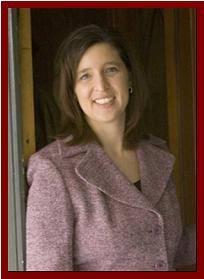
Senator Kamala Devi Harris is a formidable centrist candidate for Vice President of the US. As a prosecutor and state Attorney General, she built up a solid record on law enforcement, with a moderate commitment to judicial and police reform (far more evident in recent months than during her years in law enforcement). On healthcare, she is a centrist much in Joe Biden's mold. In fact, Biden probably picked her because she was so much like him in her politics ("simpatico" was his first criterion!). Like George HW Bush and Joe Biden, she has been picked because her presidential run exposed her to the whole country and demonstrated she was ready for the presidency even though she failed to win. Unlike Biden (who never led the polls in either of his previous runs for president, in 1988 and 2008), Kamala Harris was the Democratic front-runner for more than a month last year after her strong performance in the first two Democratic presidential debates.
Saturday, October 10, 2020
Kamala Devi Harris and the American Dream
Tuesday, August 12, 2008
Remembering John Kenneth Galbraith (1908-2006)

Had I not received a letter from John Kenneth Galbraith dated July 7th 1983, I would not have perhaps chosen a career in Economics. Just the previous summer, the school library of St. Paul’s at Darjeeling acquired a new collection of books that included two books by John Kenneth Galbraith, The Affluent Society (1958) and The New Industrial State (1967). The astringent wit and elegant iconoclasm of John Kenneth Galbraith bewitched me in those years and this triggered a chain of correspondence between Cambridge and Darjeeling. I became a Galbraith aficionado early in life and began to read and collect everything that Galbraith wrote and lectured. I was disillusioned later in graduate school when I found the mainstream of academic Economics neoclassical and Samuelsonian that formed the basis of all higher education in Economics.
John Kenneth Galbraith personified through his life and work what Keynes called “a master economist.” A master economist who, according to Keynes (1933) “possessed a rare combination of gifts...” and could be “a mathematician, historian, statesman and philosopher in some degree.” John lived a complete and fulfilled life. He worked in the Roosevelt and Truman administrations, wrote speeches for Adlai Stevenson, served as ambassador to India during the Kennedy administration, turned down Lyndon B. Johnson's offer of the directorship of the Peace Corps, and as a self-described ''independent operator at the guerrilla level of American politics" played notable roles in the presidential campaigns of Eugene McCarthy and George McGovern. He was also one of the first and most vocal opponents of US involvement in Vietnam. According to John’s neighbor Anne Bernays, ''He was an incredibly smart man. He knew everything, he remembered everything, and he got you on everything. He always had the last word, but in a wonderful way." John was that Harvard economist, who revised each of his books at least five times and was as much a man of letters as a social scientist. John’s style of writing was rigorously burnished and was reminiscent of the 18th century Enlightenment philosophe. He was a thinker as devoted to crafting pellucid prose as shaping public policy. John titled his autobiography A Life in Our Times (1981) and his political career was encapsulated in his Annals of an Abiding Liberal (1979).
John enjoyed a lasting association with the Kennedy family. He was John Kennedy’s tutor at the Winthrop house in Harvard. He was a pillar of the New Frontier, and his presence did much to lend its academic cachet to John Kennedy’s administration. At the 1956 democratic national convention, Kennedy had narrowly lost the vice-presidential nomination, a loss owing to a stand on agricultural price supports John had warned against. Afterward, Kennedy told him, ''I don't want to hear about agriculture from anyone but you, John. And I don't want much to hear about it from you either."
As a reward for his work during the 1960 campaign, President Kennedy sent John to India to understand the mind of the Harrow educated Kashmiri Brahmin elite that was Jawaharlal Nehru. ''The job of an American ambassador," he later explained, ''is to maintain civil communication with the government to which he is accredited and, to the extent that personality allows, to personify the majesty and dignity of the United States. No one should suppose that this is either intellectually or physically taxing." Indeed, John managed to write no fewer than four books while in India: The Scotch (1964), Economic Development (1962), Ambassador's Journal (1969), and the first of his three novels, The McLandress Dimension (1963), which he published under the pseudonym Mark Epernay. He also began work on Indian Painting (1968). ''It is my only writing to which, to my knowledge, no one has ever taken serious exception" wrote John.
During the '50s John published a number of books: American Capitalism (1952) and A Theory of Price Control (1952), The Great Crash (1955), which one reviewer called the ''wittiest book ever written by a professional economist," and The Affluent Society (1958). The latter, with its critique of a consumer-driven economy of excess, made him a celebrity. It was translated into a dozen languages and went on to sell some 1.5 million copies. It also added a new phrase to the language, "the conventional wisdom," which John spent the rest of his life subverting. Two of John’s favorite novelists, Anthony Trollope and Evelyn Waugh, had a more discernible effect on his work than any economist did. Their wit, clarity, and keen eye were qualities he prized highly -- and consistently demonstrated throughout his own work.
In 1967, John published what he considered to be his most important book, The New Industrial State(1967). It, too, was an international bestseller, with its examination of ''the economic, political, and social theory of that part of the economy by now preempted by the large corporations." Along with The Affluent Society (1958), it formed a trilogy completed in 1973 with publication of Economics and the Public Purpose(1973). His worldliness and wide-ranging interests put him at odds with the ever-increasing specialization of contemporary economics. He received his colleagues' highest honor in 1971, being named president of the American Economic Association, but his fondness for the generalizing epigram and distaste for quantification meant his greatest following was among lay readers rather than fellow economists. Even more than John Maynard Keynes, it was Thorstein Veblen (1857-1929), the author of The Theory of the Leisure Class (1899) a classic amalgam of social science and social criticism, who provided John with his model: the economist as social critic. I must admit that I was profoundly influenced and indoctrinated by this model of an economist as a social critic, a reason that led me to James M. Buchanan’s Public Choice and Amartya Sen and Abraham Bergson’s Social Choice as my primary fields of graduate study in Economics.
John once wrote, ''I never imagined that there was any point to being an economist if no one was aware of what you were thinking" (1968). Many years later when I am running for the Mayor of my hometown in a part of the world where President Kennedy once sent John to represent his country, I am reminded of John and his role of an economist as a social critic. A role that I hope to play as well as I learnt from him as a reader and an aficionado.
Friday, December 28, 2007
James M. Buchanan and the Virginia School of Political Economy

In the second half of the 20th century, the Virginia school of political economy has emerged as an important research program that explores the boundary between law, economics and politics. Although that research program is now carried out by many prominent economists and political scientists around the world, the work and personality of James Buchanan has always played an important role in its development, and in its appeal. http://rdc1.net/forthcoming/jmbvap.pdf
"Buchanan's book, The Calculus of Consent (1962), co-authored with Gordon Tullock, is considered one of the classic works that founded the discipline of public choice, a melding of economics and political science. In particular (1962, p. v), the book is about the political organization of a free society. But its method, conceptual apparatus, and analytics "are derived, essentially, from the discipline that has as its subject the economic organization of such a society."
The Calculus of Consent argues that government decisions are part of the economy, not exogenous factors. Therefore, methods of collective decisions must be studied as part of the study of the public sector. Calculus further describes the constitution as the line that is drawn between private and collective action. Public choice is then divided between pre- and post-constitutional phases.
Buchanan has also written extensively on the theory of the fiscal constitution. His work The Power to Tax: Analytical Foundations of a Fiscal Constitution (with Geoffrey Brennan) was ground breaking on how fiscal decisions are made. Buchanan's writings have also challenged traditional assumptions about the role of self interest in political decision making.
Public Choice theory has evolved into two branches — a normative branch which attempts to derive principles of an appropriately organized set of public decisions, and a positivist branch which attempts to develop predictive theories of behavior.
Major Works of James M. Buchanan
The Pure Theory of Public Finance: A suggested approach", 1949, JPE
"Individual Choice in Voting and the Market", 1954, JPE
"Social Choice in Voting and Free Markets", 1954, JPE
Public Principles of Public Debt, 1958.
"Positive Economics, Welfare Economics and Political Economy", 1959, J Law Econ
Fiscal Theory and Political Economy, 1960.
"Externality", with W.C. Stubblebine, 1962, Economica
The Calculus of Consent: Logical foundations for constitutional democracy, with G. Tullock, 1962.
"What Should Economists Do?", 1964, Southern EJ
"Ethical Rules, Expected Values and Large Numbers", 1965, Ethics
"Economics and Its Scientific Neighbors", 1966, in Krupp, editor, Structure of Economic Science
Public Finance in Democratic Process: Fiscal institutions and democratic choice, 1967.
Demand and Supply of Public Goods, 1968.
"An Economist's Approach to Scientific Politics", 1968, in Parsons, editor, Perspectives in the Study of Politics.
Cost and Choice: An inquiry into economic theory, 1969.
"Is Economics the Science of Choice?", 1969, in Streissler, editor, Roads to Freedom
"Notes for an Economic Theory of Socialism", 1970, Public Choice
Academia in Anarchy, with N.Devletoglou, 1971.
"Equality as Fact and Norm", 1971, Ethics
"Before Public Choice", 1973, in Tullock, editor, Explorations in the Theory of Anarchy
The Limits of Liberty: Between Anarchy and Leviathan, 1975.
"Public Finance and Public Choice", 1975, National Tax Journal
"A Contractarian Paradigm for Applying Economic Theory", 1975, AER
"Barro on the Ricardian Equivalence Theorem", 1976, JPE
"Methods and Morals in Economics", 1976, in Breit and Culbertson, editors, Science and Ceremony
Democracy in Deficit: the political legacy of Lord Keynes, with R.E. Wagner, 1977.
"Markets, States and the Extent of Morals", 1978, AER
Freedom in Constitutional Contract, 1978.
What Should Economists Do?, 1979.
The Power to Tax: the analytical foundations of a fiscal constitution, with G. Brennan, 1980.
"The Homogenization of Heterogeneous Inputs", with R.D. Tollison, 1981, AER
"The Domain of Subjective Economics: Between predictive science and moral philosophy", 1982, in Kirzner, editor, Method, Process and Austrian Economics
"Order Defined in the Process of Emergence", 1982, Literature of Liberty
The Reason of Rules: constitutional political economy with G. Brennan, 1985.
Liberty, Market and the State, 1986.
"The Constitution of Economic Policy", 1987, AER
Economics: between predictive science and moral philosophy, with G. Brennan, 1988.
Explorations in Constitutional Economics, 1989.
The Economics and Ethics of Constitutional Order, 1991.
"From the Inside Looking Out", 1991, in Szenberg, editor, Eminent Economists
Constitutional Economics.
Better than Ploughing and other personal essays. 1992
"Economic freedom and competitive federalism: prospects for the new century", 1996, Nobelists for the Future
"Generalized Increasing Returns, Euler's Theorem, and Competitive Equilibrium" with Yong J. Yoon, 1999, HOPE
Collected Works of James M. Buchanan, 1999
Friday, December 7, 2007
Paul Milgrom and the Masterclass of Auction theorists
Dr. Milgrom is an expert in game theory, specifically auction theory and pricing strategies. He is also the co-discoverer of the no-trade theorem with Nancy Stokey, and the co-founder of three companies: Market Design, which consults on the design of auction markets, Spectrum Exchange, which facilitates the exchange of radio spectrum toward those who will get the best use out of it, and Perfect Commerce, which provides support for electronic commerce.
Paul Milgrom and the Masterclass of Auction theorists
http://www.sss.ias.edu/publications/papers/econpaper44.pdf
Major Works of Paul Milgrom:
Milgrom, Paul (1979). The Structure of Information in Competitive Bidding. New York: Garland Press. (Ph.D. Dissertation)
Milgrom, Paul (1979). "A Convergence Theorem for Competitive Bidding with Differential Information". Econometrica 47: 679-88.
Milgrom, Paul (1981). "Good News and Bad News: Representation Theorems and Applications". Bell Journal of Economics 12: 380-91.
Milgrom, Paul and John Roberts (1982). "Limit Pricing and Entry Under Incomplete Information: An Equilibrium Analysis". Econometrica 50: 443-59.
Milgrom, Paul and John Roberts (1982). "Predation, Reputation, and Entry Deterrence". Journal of Economic Theory 27: 280-312.
Milgrom, Paul and John Roberts (1990). "The Economics of Modern Manufacturing: Technology, Strategy and Organization". American Economic Review 80(3): 511-28.
Milgrom, Paul and Nancy Stokey (1982). "Information, Trade and Common Knowledge". Journal of Economic Theory 26: 17-27.
Milgrom, Paul and Robert Weber (1982). "The Value of Information in a Sealed Bid Auction". Journal of Mathematical Economics 10: 105-14.
Milgrom, Paul and Robert Weber (1982). "A Theory of Auctions and Competitive Bidding". Econometrica 50: 1089-1122.
Milgrom, Paul and Robert Weber (1985). "Distributional Strategies for Games with Incomplete Information". Mathematics of Operations Research 10: 619-32.
Milgrom, Paul (2004). Putting Auction Theory to Work. Cambridge University Press. ISBN 0-521-53672-3.
Friday, November 23, 2007
Axel Leijonhufvud on Life Among the Econ
Friday, November 9, 2007
Bono in Economics department at MIT

"When the going gets weird, the weird turn pro," wrote Hunter S. Thompson (1971). Bono's visit to the Economics department at MIT surrouded by eminent economists Bengt Holmstrom and Abhijit Banerjee is just another instance where the weird rock star might have turned into a pro of development economics. Are we to expect a nobel prize for Bono for his promotion of development agendas at the grassroots level any time soon? Can MIT endorse him for such a prize? Is such a prize likely after the former U.S. vice president Al Gore received one for a similar type of contribution? Is the Economics Nobel Prize and the Nobel Peace Prize increasingly overlapping? If "Development is Freedom" as Sen has suggested (Sen, 2001), are we to expect that freedom to be our new Economic Imperialism? (Lazear, 1999) Is that good news for our profession?
http://faculty-gsb.stanford.edu/lazear/Personal/PDFs/economic%20imperialism.pdf
(Photo courtesy: Abdul Latif Jameel Poverty Action Lab, MIT)
Kaushik Basu on Globalization and the Politics of International Finance
Thursday, November 8, 2007
A Prize for a Brave Man: Abhijit V. Banerjee on 2006 Nobel Peace Prize Winner
Source: http://www.exectimes.com/content/nov06/cov04.asp


The Nobel Peace Prize is often a prize for courage. When we think of the prize we think of Andrei Sakharov in banishment, or Nelson Mandela in his South African prison. This year's prize is for a different kind of bravery, the bravery it takes to believe in an idea and to pursue it. Dr. Yunus literally put his money, as the American expression goes, where his mouth is. In 1976, he lent 27 of his own dollars (which must have been a significant part of his professor's salary then) to 42 poor borrowers.
It probably took even more intellectual courage, and the clarity he is famous for, to take the next step-to draw the right lesson from the fact that they all paid it back. Not the lesson that a more vain man might have drawn, that they were responding to his unexpected munificence-of course they were-but the much more important fact, that even the very poor can take a loan and repay it, when it makes sense for them to do so. You can lend to the poor, just like you can lend to any one else, and like everyone else, how easily you can get them to pay it back depends, in part, on their incentives. The promise of a future loan does make it easier to collect, especially with the poor who often have no one else who would lend to them. But you also need to do your due diligence: make sure that the borrowers are really in it for the long-haul, keep an eye on them to make sure that things are not going too far wrong, prod them a little when they are late. Like any other banker.
What makes lending to the poor harder is simply the fact that they borrow so little-a loan of a few thousand Takas is a sizeable loan for them. In part this is due to their own diffidence (what would I do with so much money?), but it is also because lenders worry about how someone would react if he were handed much more money than he has ever had. Would she know how to use it responsibly? Or, would it be just too tempting to take and run?
The trouble is, even though they borrow very little, much of the work the lender has to do to be able to lend to them - the so-called transactions costs - finding out where they live, what they do, what business they are in, collecting the money, etc-is not that different from what is involved in making a bigger loan. This is why most lenders do not want to lend to them, and when they do lend, the interest rate they charge tends to be very high.
Yunus' great practical insight was that the challenge was to get the transactions costs down. This he made his life's work. This is why Grameen has the weekly meetings with multiple groups (so that a single loan officer can collect from many people at the same time), the group loans (so that all the members have a stake in making sure that the others pay), the attempts to standardize the loans (eliminates the need to make a lot of calculations). All the group activities, like the chanting of the four principles, feed into this as well (though they may also be important for other reasons): By helping to build a Grameen identity, they help to mitigate the usual adversarial relationship between the borrower and the lender.
None of this was obvious in 1976. I am not quite of the Dr. Yunus' generation, but I am old enough to remember what most economists were talking about then: It was socialism versus capitalism, the inevitability of the revolution, the miracle of the market, big questions that could be endlessly debated. To walk away from all that and to bury yourself in the nitty-gritty details of how best to lend a few Taka to a few desperately poor women, must have taken enormous courage. When everyone else was busy changing the system, what he was trying to do must have felt utterly trivial at times. It must have taken a lot to keep going. We are grateful that he did.
The early efforts, as he describes in his book, did not always go well. Sometimes the group size was too large; sometimes the loan size was wrong. It took a lot of experimentation, and willingness to learn from mistakes to get there. But they got there. The Grameen Bank now charges a maximum of 10 percent per year, conventionally calculated, compared to interest rates of 50% or more that money-lenders and other private bankers charge the poor.
The size of that gap, reflects in part the benefits of even small reductions in transactions cost: One insight from the recent work on the economic theory is that reductions in transactions costs come with what economists call a multiplier-one fall in transactions costs creates another. This is because the initial fall in transactions cost made it possible for Grameen to cut its interest rates; but a lower interest rate makes it less likely that a borrower would want to default, which makes life easier for the lender and reduces transactions costs further, which allows Grameen to cut the interest rate more and so on. This is probably one reason why Grameen can offer loans that are so much cheaper than the market.
The other reason is of course, subsidies. Grameen gets a substantial amount of subsidies from donors, which it can pass it on to its borrowers in the form of an interest rate that is below what it costs to deliver the loan. From the point of view of the relation between the borrower and lender, it does not matter whether the cut in the interest rate comes from a lowered transactions cost or a subsidy. Both set off the multiplier, so that the fall in the interest rate can be much bigger than what one would have otherwise anticipated (say based on the size of the subsidy).
For this reason, subsidies given to micro-credit organizations can be a very effective way of helping the poor, as long as it does not undermine the professionalism of the organization that is doing the lending. This is why Dr. Yunus has always resisted the almost religious opposition to all subsidies one often comes across in the Microfinance community, especially outside South Asia. The argument that is usually made is that the reliance on subsidies will limit the ability of these organizations to grow, which might have been true had it not been for Dr. Yunus' almost magical ability to get the world to see micro-credit as he sees it.
Indeed the danger at this point is that the world may be all too persuaded. Donors love it, and expect it to do miracles; I have even heard how it will help with AIDS in Africa (it might, because anything that brings hope might help, but it hardly seems an open and shut case). Yet we still do not have a scientific evaluation of the impact of micro-credit even on simple outcomes like family earnings-the early attempts to do impact evaluations have had obvious flaws, and together fall well short of a ringing endorsement. Several evaluations that should be much more credible are under way now, but it will, be some years before we start sorting out real sense of how what micro-credit can and cannot do. In the meanwhile all we really know is that it has logic in its favor, and the felt experience of many honest and clear-sighted men like Dr. Yunus.
Dr. Yunus knows the dangers of inflated expectations. This summer, when we were fortunate enough to spend a couple of hours listening to him in his office in Dhaka, he talked animatedly about the many things that still needed to be done: Bigger loans that allow businesses to grow, ways to help talented children of the poor to go college, something to help those who are too poor even to get micro-credit, and many others. Some of those have been launched already-the rest are on the anvil. They are experiments, he said-the search for better answers continues. A brave man with the will to keep trying: congratulations to him.
Thursday, November 1, 2007
Susan Athey Awarded the John Bates Clark Medal 2007

Susan Athey will be long remembered as the most prodigious and sought- after graduate student of her time. In a 1995 New York Times profile, one of her doctoral advisors, John Roberts, declared her a Superwoman. She was only 24.
http://kuznets.fas.harvard.edu/~athey/publicity/NYTimes.pdf
The American Economic Association had announced this summer that Susan Athey, professor of economics in the Faculty of Arts and Sciences (FAS) at Harvard University, is the 2007 recepient of the John Bates Clark Medal. Widely considered one of the most prestigious awards in the field of economics, the biannual award goes to an economist, under the age of 40, who has made a significant contribution to economic thought and knowledge. Athey is the first woman to receive the medal. Athey's major contribution stems from her Stanford doctoral dissertation on Monotone comparative statics in stochastic optimization problems and their applications done under the supervision of two Stanford Auction theory gurus, Paul Milgrom and John Roberts.
Major Works of Susan Athey:
Refereed Publications:
"The Optimal Degree of Monetary Policy Discretion," (with Andrew Atkeson and Patrick Kehoe), Econometrica 73 (5), September, 2005, 1431-1476.
"Collusion and Price Rigidity," (with Kyle Bagwell and Chris Sanchirico). Review of Economic Studies 71 (2), April 2004, 317-349.
"Identification in Standard Auction Models," (with Philip Haile), Econometrica, 70 (6), November 2002, pp. 2107-2140.
"The Impact of Information Technology on Emergency Health Care Outcomes," (with Scott Stern), RAND Journal of Economics, 33 (3), Autumn 2002, pp. 399-432.
"Monotone Comparative Statics Under Uncertainty," Quarterly Journal of Economics, February 2002, CXVII (1): 187-223.
"Optimal Collusion with Private Information," (with Kyle Bagwell), RAND Journal of Economics, Autumn 2001, 32 (3): 428-465.
"Single Crossing Properties and the Existence of Pure Strategy Equilibria in Games of Incomplete Information," Econometrica 69 (4), July, 2001: 861-890.
"Information and Competition in U.S. Forest Service Timber Auctions," (with Jonathan Levin), Journal of Political Economy, 109 (2), April 2001. Reprinted in: Empirical Industrial Organization, Paul Joskow and Michael Waterson, ed., Critical Ideas in Economics, Edward Elgar, forthcoming 2004.
"Investment and Market Dominance," (with Armin Schmutzler), RAND Journal of Economics 32 (1), Spring 2001: 1-26.
"Mentoring and Diversity," (with Chris Avery and Peter Zemsky), American Economic Review 90 (4) September 2000: 765-786.
"Product and Process Flexibility in an Innovative Environment, "(with Armin Schmutzler), RAND Journal of Economics, 26 (4) Winter1995: 557-574.
Papers and Proceedings/Books/Conference Volumes
Dynamic Games and Contracts with Hidden Information, In Progress. Toulouse Lectures in Economics 2007, Princeton University Press.
"Designing Efficient Mechanisms for Dynamic Bilateral Trading Games," (with Ilya Segal), American Economic Review Papers and Proceedings, May 2007, forthcoming.
"What Does Performance in Graduate School Predict? Graduate Economics Education and Student Outcomes" (with Larry Katz, Alan Krueger, James Poterba, and Steve Levitt), American Economic Review Papers and Proceedings, May 2007, forthcoming.
"Empirical Models of Auctions," in Advances in Economics and Econometrics: Theory and Applications, Ninth World Congress, Volume II. Richard Blundell, Whitney K. Newey, Torsten Persson, eds., Cambridge University Press, 2007.
"Nonparametric Approaches to Auctions," forthcoming, Handbook of Econometrics, Volume 6.
Robust Comparative Statics (with Paul Milgrom and John Roberts), research monograph (draft form).
"Organizational Design: Decision Rights and Incentive Contracts," (with John Roberts), American Economic Review Papers and Proceedings, May 2001.
"Adoption and Impact of Advanced Technologies in Emergency Response Systems," (with Scott Stern), in The Changing Hospital Industry: Comparing Not-for-Profit and For-Profit Institutions, David Cutler, ed. University of Chicago Press, 2000, pp. 113-155.
"Information Technology and Training in Emergency Call Centers." (with Scott Stern). Proceedings of the Fifty-First Annual Meetings (New York, Jan 3-5, 1999). Madison, WI: Industrial Relations Research Association, pp. 53-60.
Source:http://kuznets.fas.harvard.edu/~athey/cv.html
Tuesday, October 30, 2007
Two distinguished students of Eric S. Maskin


Abhijit Banerjee's 1988 Harvard doctoral dissertation titled "Essays in Information Economics" dealt with informational imperfections in the information transmission process. In many respect, he was the pioneer of the applications of mechanism design to development economics, as problems of underdevelopment often related to problems of incomplete information and imperfect credit. The latter problem was tackled by Maitreesh Ghatak also under the supervision of Eric Maskin at Harvard.
Monday, October 29, 2007
Major Works of Eric S. Maskin

Eric S. Maskin
"An Equilibrium Analysis of Search and Breach of Contract", with P.A. Diamond 1979, Bell JE
"The Implementation of Social Choice", with P. Dasgupta and P. Hammond, 1979, RES
"A Differentiable Approach to Expected Utility Maximizing Mechanisms" with J.J. Laffont, 1979, in Laffont, editor, Aggregation and Revelation of Preferences
"A Differentiable Approach to Dominant Strategy Mechanisms" with J.J. Laffont, 1980, Econometrica
"The Theory of Incentives" with J.J. Laffont, 1982, in Hildenbrand, editor, Advances in Economic Theory
"Monopoly with Incomplete Information", with J. Riley, 1984, Rand JE
"Optimal Auctions with Risk Averse Buyers", with J. Riley, 1984, Econometrica
"Auction Theory and Private ValueS", 1985, AER
"An Example of a Repeated Partnership Game with Discounting and with Uniformly Inefficient Equilibria", with R. Radner and R.B.Myerson, 1986, RES
"The Existence of Equilibrium in Discontinuous Economic Games", with P. Dasgupta, 1986, RES
"Optimal Non-Linear Pricing with Two-Dimensional Characteristics" with J.J. Laffont and J.C. Rochet, 1987, in Groves et al., editors, Information, Incentives and Economic Mechanisms
"The Principal-Agent Relationship with an Informed Principal", with J. Tirole, 1990, Econometrica
"Renegotiation in Repeated Games", with J. Farrell, 1989, Games and Econ Behav
"Repeated Games with Long Run and Short Run Players", with D. Fudenberg and D. Kreps, 1990, RES
"Nash and Perfect Eqilibria of Discounted Repeated Games", with D. Fudenberg, 1990, JET
Sunday, October 28, 2007
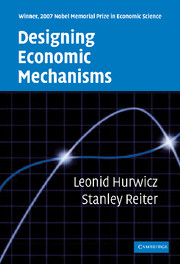
2007 Economics Nobel awarded to three American Mechanism Design theorists
The gap in knowledge between buyers and sellers, and the costs and consequences for the efficient operation of a market, is at the heart of the groundbreaking research by the winners of this year's Nobel prize in economics. Three US-based economists - the game theory pioneer Leo Hurwicz, along with Eric Maskin and Roger Myerson – were today awarded the 2007 prize for work spanning 50 years in a branch of game theory that has come to be known as mechanism design.
In its statement announcing the award, the Nobel committee said: "The theory allows us to distinguish situations in which markets work well from those in which they do not. It has helped economists identify efficient trading mechanisms, regulation schemes and voting procedures."
A mechanism is a mathematical structure that models institutions through which economic activity is guided and coordinated. There are many such institutions; markets are the most familiar ones. Lawmakers, administrators and officers of private companies create institutions in order to achieve desired goals. They seek to do so in ways that economize on the resources needed to operate the institutions, and that provide incentives that induce the required behaviors. Their works represent systematic procedures for designing mechanisms that achieve specified performance, and economize on the resources required to operate the mechanism. The systematic design procedures are algorithms for designing informationally efficient mechanisms. When there are finitely many environments to be dealt with, and there is a Nash-implementing mechanism, our algorithms can be used to make that mechanism into an informationally efficient one. Informationally efficient dominant strategy implementation is also studied.
While highly abstract and mathematical, mechanism design theory has concrete applications in the real world, it can provide important justifications for government intervention in the operation of markets such as health care, as well as helping to construct rules that attempt to avoid the disparity in information between groups of buyers and sellers.
That gap in knowledge is known in economics as "information asymmetry" and it has become one of the most widely studied aspects of the discipline. In recent years economists such as George Akerlof and Joseph Stiglitz have been awarded Nobel prizes for their work in the field.
Because sellers have an incentive to seek the highest possible sale price, and buyers have the opposite incentive, and both parties have different levels of knowledge about the overall value of the transaction, the final outcome may not efficient for the economy as a whole. Mechanism design theory attempts to identify these breakdowns and avoid them where possible.
Hurwicz began working on forms of game theory with the influential economist Kenneth Arrow, who first outlined the pitfalls of information asymmetry in the 1960s and was awarded the Nobel prize in economics in 1972. But Arrow's work built on some of Hurwicz's research in the 1950s, and Hurwicz was regarded as having been overlooked, until now.
Myerson is a prolific author of academic papers and computer software tackling the subject. He is best known as one of the authors of an influential principle in mechanism design theory, the Myerson-Satterthwaite theorem, which finds that one side of a transaction stands to make a loss of some kind when two parties trade a good where they each have hidden and differing information.
Maskin has worked on the optimal design of auctions, alongside his colleague John Riley, and was hired to advise the Italian government on the operation of its bond auctions. He has previously worked as a research student and visiting fellow at Cambridge University.
Source: http://business.guardian.co.uk/economy/story/0,,2191731,00.html